Uncle Cephas was raised not in a blue-state, but in deep indigo ones.
However, Democratic playing of politics has gone way to far.
The World War II memorial, in ordinary times, does not even have an attendant. A reasonably healthy pedestrian may readily access it. Yet, during the shutdown, a group of veterans in their 80's and '90's was barry-caded from it. I salute them that they stormed it.
However, the Washington Mall is wide open to a demonstration in favor of regularizing the status of illegal immigrants.
In both cases, the administration agrees to pay for things during a shutdown.
Yes, the Democrats are playing cynical politics, too.
Please, Senators Mikulski and Cardin, if the Affordable Care Act is so wonderful, why do you and your colleagues in the House and Senate exempt yourselves? Why is Mr. Obama allowed to change it about five times by presidential fiat, but it becomes sacred when a Republican House wants to amend it--especially when the House is the constitutionally-mandated place to begin all bills for appropriations?
Wednesday, October 9, 2013

Monday, September 23, 2013
The Bloody Borders of Islam--Again
The late Samuel Huntington noted that conflict arises easily along the borderlands of major cultural areas, especially noting the bloody borders of Islam. When first exposed to this thesis, I wanted to call to mind the Thai-Malaysian border as it was back in the 1990's. It was an area of trade and international cooperation, promising that maybe ASEAN could work. Since then, however, the Muslim separatism groups of southern Thailand have roared back with a vengeance, wrecking one of the few counterfactuals to the Huntington thesis that I knew.
The attack in Nairobi also seems to be part of a similar Huntingtonian dynamic, suggesting that the whole belt of Africa from Senegal and Guinea on the west, across northern Nigeria,and into the East African Horn is at risk. These are all states where large numbers of non-Muslims share political space with large numbers of non-Muslims,the Muslim population is becoming more doctrinally aware, and there are few common bonds between communities. Southern Sudan has already separated from the Islamic north of the country, Nigeria is plagued by the militancy of Boko Haram and other groups, Somali Muslim irredentism has not disappeared despite the failure of Somalia as a state, and Ethiopia continues to live with its religiously bifurcated population. We can no longer warn about a tinderbox in these areas, for the tinder was lit long ago, and, as the Nairobi attacks warn us, the fire has begun.
The continent of Africa continues to need our prayers and sympathy. It is in for a rough ride.
Saturday, September 21, 2013
Robert L. Reymond, R.I.P, and alov hasholom
Ligonier ministries has recently announced that Dr. Robert L. Reymond, a minister of the Orthodox Presbyterian and Presbyterian Church in America denominations, has gone to be with the Lord.
Uncle Cephas cannot claim to be either a close friend or a family member of the deceased, but nonetheless feels blessed to have been a student of Dr. Reymond's at Covenant Theological Seminary in St. Louis during the years 1975-79. Dr. Reymond passed on a deep appreciation for the study of systematic theology, while his exegetical skills profoundly impressed me that systematic theology is both an exercise in the logical ordering of Christian belief and profoundly rooted in the Scriptures of the Old and New Testament. He was very truly a theologian of the Word.
Dr. Reymond also had a large, warm pastoral and evangelistic heart, seeking that men everywhere and in all stations of life might know the surpassing greatness of the Lord Jesus Christ, to the praise of God's glorious grace. While he encouraged deep and thorough study, and probably helped shape not a few academic theologians, he never lost sight of the task of educating pastors and others whose work would be to communicate the Gospel to a dying world. Further, he cared deeply about the younger men whom he taught. To this day, I will always think of his rich, warm baritone voice, so impressive in either pulpit or lecture hall, addressing us as "brothers". We all chuckled at the tone in which it was delivered, but I think few doubted that he was sincere in seeing us as his brethren in the Saviour.
Uncle Cephas was glad and remains glad to have learned the outline of Reformed theology from such a brother. True, I lean more towards the classic Reformed position that the man of Romans 7 covers even the best of Christians (such as Paul, as he penned those lines "Wretched man that I am") rather than the man under conviction (a position Dr. Reymond shared with Martin Lloyd-Jones), and perhaps am sometimes more postmil than amil. Noting Dr. Reymond's liberal use of the NIV for the scriptural quotes in his Systematic Theology, he perhaps had a broader view of what Scripture translation should and could be (Uncle Cephas prefers a Bible that does not leave out such words as "propitiation"). I will always remember Dr. Reymond as a teacher who was incisive, thorough, and sympathetic.
May God comfort his family, friends, associates, and former students in this time of mourning. Blessed are the dead who die in the Lord (Rev. 14:13).
Had to add that. Dr. Reymond seldom conversed without the words of Scripture somewhere near at hand. At the risk of the flippancy of which Dr. Reymond disapproved--see you when the dead in Christ arise (I Thes. 4:16), Brother Bob.
Sunday, September 1, 2013
Random Thoughts on Babel
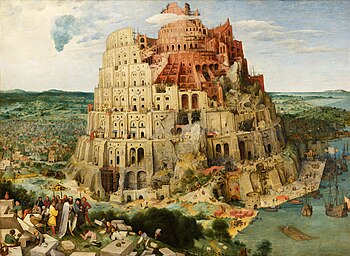 Welcome to another rambling meditation. Image: Pieter Brueghel the Elder
Our adult Sunday School class has been going through the Old Testament book of First Samuel. During discussion of the Israelites' desire for a king (I Sam. 8), the Tower of Babel came up.
It's really an interesting story:
And the whole earth was of one speech. And it came to pass, as they journeyed from the east, that they found a plain in the land of Shinar; and they dwelt there. And they said one to another, Go to, let us make brick, and burn them thoroughly. And they had brick for stone and slime had they for mortar. And they said, Go to, let us build us a city and a tower, whose top may reach unto heaven; and let us make us a name, lest we be scattered abroad upon the face of the earth. And the LORD came down to see the city and the tower, which the children of men had builded. And the LORD said, Behold, the people is one, and they have all one language; and this they begin to do: and now nothing will be restrained from them, which they have imagined to do. Go to, let us go down, and there confound their language that they may not understand one another's speech. So the LORD scattered them abroad from thence upon the face of the earth; and they left off to build the city. Therefor is the name of it Babel; because the LORD did there confound the language of all the earth; and from thence did the LORD scatter them abroad upon the face of the earth.
These are the generations of Shem...(Gen.11:1-10, AV)
Having recently had my elder son and his family move back in (he is pursuing a Master's) and entertaining my younger while he is home from college, I feel a sneaking pride in playing the patriarch of a three-generation family. To have those over whom one has once exercised authority gathered around is a satisfying feeling. Write it large, and you have the perennial centralizing temptations of power.
The Land of Shinar is lower Mesopotamia, and Babel is the Hebrew name for the city of Babylon. "Babel" means "Gate of God", and the city was the center of the region's first centralized absolutist state. The book of Genesis reads this back into the immediate post-deluvian era, and gives us a warning about the dangers of such totalitarian centralization.
It is the divine plan for humans to spread; to subdue the whole earth. It is the divine plan for a man to leave his father and mother and cleave to his wife (Gen.2:24--and Hebrew, being hopelessly gendered, makes it clear that it's man and _female_ wife). This is how the human race is to live, grow, propagate itself, and survive.
Hence, Moses, as editor of Genesis, warns us of the temptation of centralized power. It both keeps the family of man from fulfilling its mission of spreading out and provokes divine jealousy. It begins with a proud challenge to Heaven, and ends with confusion, when Babel, the Gate of God, descends to become Balal, or confusion.
Has this not been the story of the rise and fall of kingdoms throughout history? Is it not the case that the Thousand-year Reich lasted for exactly twelve, while the Soviet state that was to usher in the final stage of history collapsed after seventy years, leaving some who had seen the birth of the Soviet Union alive to see its demise?
And what of those who were free while under the rule of God, who suddenly decide to be "like the nations round about." (I Sam. 8:5.20). To be a free people with the knowledge of God is not to be in anarchy, but to have God for a ruler--the ultimate blessing a society may enjoy. But to trade it for the proud tower of an all-powerful earthly ruler is to invite the very confusion and dispersion such a powerful state is established to avoid. This, perhaps, is the ultimate lesson of both the Tower of Babel and the narrative of Samuel-Kings. The hoped-for "Babel" invariably becomes"Balal"--a confusion of tongues.
Moral Conundrum in Syria
I've just watched Peggy Noonan on ABC's _This Week_. She was stressing the moral dimension of President Obama's proposed intervention in Syria, saying that it was necessary to underscore the immorality of using poison gas.
But, by the same token, do we wish to support the rebels, who are trying to cleanse their areas of Syria of the ancient Christian communities resident in them? Syrian Christianity predates even the conversion of Paul the Apostle, who, after all, received baptism from a Damascene named Ananias (Hananiah) while sheltering in the home of another named Judas. This would place the beginnings of the Syrian churches in the years immediately following the death and resurrection of Jesus Christ. Support for the Syrian rebels thus is support for genocide, an issue against which we supposedly came down firmly in Bosnia and Kosova during the Clinton administration.
Granted, the Assad regime is an odious one modeled on interwar European fascism and kept in power largely by the lingering effects of Cold War-era Soviet Communist strategic interests which post-Communist Russia apparently wishes to continue. However, support for the Syrian is also fraught with moral conundrums.
Tuesday, August 27, 2013
On the Coming Syrian Intervention
My views on Syria: oh, please, NO! We shouldn't go!
I've been listening to the news and now understand that the Obama administration wishes to commit us and allies to the support of the Syrian rebels. I am going public to declare myself a dissenter and critic of this policy.
First of all, I am not a man of the Left who instinctively sees in the exercise of US power a force for evil. I view myself as a God, country, property rights, gun ownership (by the law abiding), anti-sexual revolution, limited government conservative. I also believe that historically, America has been in the right. I believe that our confrontation with the Communist states throughout the Cold War was right--and a position forced on us by the machinations of Stalin and his minions (including China's Mao Zedong and Viet Nam's Ho Chi Minh, both of whom I view as fundamentally vicious).
But where is the pressing national interest in Syria? Are we defending allies' oil supplies? No. Are we stopping an aggressive ideology that has pledged itself to our destruction? No. Will the Middle Eastern balance of power be radically altered? Possibly, but in ways that are problems for Turkey, Israel, and Iran rather than us. Will this bring us closer to a comprehensive Middle Eastern peace settlement? Absolutely not, and may even make such a quest the modern equivalent of the search for the Holy Grail.
I agree that the Assad regime is odious. The Ba'ath Party was founded in imitation of the Fascist and National Socialist parties of interwar Europe. The Ba'athis have presided over the liquidation of millennia-old Jewish communities in the lands between upper Mesopotamia and the Mediterranean. They are cruel and relentless towards dissent. They were also faithful partners of the Communist Bloc throughout the Cold War. I would not want a wooden nickel of my taxes to go to helping the Ba'athis in any way.
But what of the rebels?
It has been clear to anyone who cares to look and think that the Syrian rebellion is not the benign "democratic" movement our administration (and its media shills) has been telling us it is. Its leadership is made up of Qaida sympathizers and members of the Muslim Brotherhood. As for the latter, I refer all to the writings of its chief ideologue, Seiyyid Qotb, to see how the MB hates us not simply for anything we've done, but for who we are and what we value--not least of which are political liberty, the right of dissent, and equal treatment under law for women and minorities. Qaida and the Muslim Brotherhood, in case anyone has forgotten, are the wonderful fighters for equality and justice who brought us the attacks on the World Trade Center and Pentagon in 2001. It is a complete and utter disgrace that Ambassador Chris Stevens and three others were killed probably during an attempt to carry out secret talks with Turkish representatives about arming the Libyan rebels. Now that we seem to want to put together a whole coalition to hand Syria over to the Qaida and MB fighters, it has gone beyond disgraceful.
Further, the Syrian rebels are busy attacking, killing, driving out, and raping Christians in the areas they control. Like the Ba'athi liquidation of Syria's Jewish communities, this is also the liquidation of communities that go back to the very beginning of Christianity. Paul the Apostle was himself baptized by the church in Damascus, and sheltered by first-generation Christians there by the names of Judas and Hananiah (Ananias--see Acts 9:10-19). I would urge all to peruse the web pages of the Barnabas Fund to keep up to date on the plight of these communities now.
The treatment meted out to non-Sunnite Muslims by the Syrian rebels is also disturbing. 'Alawites and Shi'ites are also targets.
Yes, our allies in Sa'udi Arabia and Turkey are backing the rebels. But whatever for? Sa'udi Arabia has a long-running feud with the Ba'athis, and now that the Cold War is over, this is no longer a community of interest between the House of Sa'ud and the USA. Turkey's regime has become Islamicist of the Sunnite variety, and it may be wiser for US policy to take close looks at how Turkey is now treating its own minorities, apostates from Islam, and other such vulnerable categories. We would do well to consult with such other allies as Greece and Bulgaria over how they may feel about a resurgent Islamicism in their former colonial master.
The Obama administration is committing us to the support of an implacable enemy force. It has never addressed the odious ideology animating the Syrian rebels, nor their links to other movements that continue to demonize and vilify the US. But it is all the more disconcerting to see the Republican Party failing in its role as opposition, and the major media's shocking complicity when it should be a watchdog against an unnecessary waste of American treasure and lives.
I would love to know if anyone else out there feels as I do.
Saturday, August 24, 2013
My Views on "New" Gospels and their Purveyors
Recently, on Huffington Post, I read an interview with Elaine Pagels discussing her new book on Revelation. After I read that she thinks John was a Jew who believed in Jesus and didn't like the Roman state, I nodded in agreement, and said a hearty "Ho-humm" to myself.
Franky, Elaine Pagels is one of the most over-rated scholars writing about New Testament-related themes. I've been profoundly unimpressed with her work ever since people near and dear to me gave me her _Gnostic Gospels_ (1979) to "set me straight" about my confessional Protestant orthodoxy.
In _Gnostic Gospels_, Pagels resoundingly flunks Ecclesiastical History 101. She posits that the Nag Hammadi texts were hidden by Coptic monks facing persecution from Athanasius, the 4th century orthodox bishop of Alexandria. However, Gnosticism was a phenomenon of the 2d and early 3d centuries, not the 4th. Athanasius and his colleagues at Nicaea in 325 whose opinions he defended were fighting Arians and Semi-Arians, not Gnostics. Moreover, Athanasius was more often than not on the receiving end of persecution, being exiled three times to the Rhine frontier by Constantine's Semi-Arian successors. As for the Coptic monks, their dean, the redoubtable hermit Anthony, came out of the desert to show support for the beleaguered Athanasius.
Further, Pagels seems to think that the Coptic "Gospel of Thomas" (probably written a couple of generations after Judas Didymus Thomas was martyred) is more pro-woman than the canonical Scriptures. The work ends with these words:
Pagels apparently likes the Jewishness of John of Patmos. Yet this is quite an inconsistency with her long championship of 2d century Gnosticism, which demonized the Old Testament and relegated its God to something far inferior to the Father of our Lord Jesus Christ. Had Pagels' beloved Gnostics "won", Christianity would never have developed a bad conscience over anti-Semitism.
Pagels is the purveyor of a myth that mitred, monarchical 4th century bishops determined the New Testament canon on the basis of whether or not a text would support their claims to power. Yet somehow, she never explains why these same purveyors of monepiscopacy allowed Luke-Acts and Philippians into the canon, when the former uses presbyter and bishop interchangeably in Acts 20, and the latter begins with a salutation to plural bishops in the single city of Philippi. She isn't alone in purveying this myth (Bart Ehrman also comes to mind). Perhaps her unsubstantiated reconstructions of Christian history are necessary to get around Irenaeus in Lyons, Clement in Alexandria, Origen in 'Eretz Yisroel, and Tertullian in North Africa all seeing four and only four Gospels during the 2d century. Or, perhaps, Pagels is someone without the slightest feel for the flow of history. Or, perhaps, as a latter-day Gnostic, she is more comfortable with myth; and thus joins a crowd of people who, claiming to find the true "historical" grounding of Christianity, are themselves lousy historians.
Pagels, the Jesus Seminar, and their ilk are lionized and feted by the media because liberal religion is finally waking up to the fact that it gets no aid or comfort from the canonical Scriptures. It must therefore clutch at straws like the mystical but misogynistic Pseudo-Thomas. No wonder the academic study of the Bible and religion are in such a sorry state.
Franky, Elaine Pagels is one of the most over-rated scholars writing about New Testament-related themes. I've been profoundly unimpressed with her work ever since people near and dear to me gave me her _Gnostic Gospels_ (1979) to "set me straight" about my confessional Protestant orthodoxy.
In _Gnostic Gospels_, Pagels resoundingly flunks Ecclesiastical History 101. She posits that the Nag Hammadi texts were hidden by Coptic monks facing persecution from Athanasius, the 4th century orthodox bishop of Alexandria. However, Gnosticism was a phenomenon of the 2d and early 3d centuries, not the 4th. Athanasius and his colleagues at Nicaea in 325 whose opinions he defended were fighting Arians and Semi-Arians, not Gnostics. Moreover, Athanasius was more often than not on the receiving end of persecution, being exiled three times to the Rhine frontier by Constantine's Semi-Arian successors. As for the Coptic monks, their dean, the redoubtable hermit Anthony, came out of the desert to show support for the beleaguered Athanasius.
Further, Pagels seems to think that the Coptic "Gospel of Thomas" (probably written a couple of generations after Judas Didymus Thomas was martyred) is more pro-woman than the canonical Scriptures. The work ends with these words:
Simon Peter said to them: Let Mary go away from us, for women are not worthy of life. Jesus said: Lo, I shall make her a male, that she too may become a living spirit, resembling you males. For every woman who makes herself a male will enter the kingdom of heaven. (Logion 114).It seems that the pseudo-Peter and the pseudo-Jesus of the pseudo-Thomas are in agreement that women as women aren't subjects of salvation. Yet for all its supposed "misogyny", the canonical, 66-book Bible never seems to suggest that Sarah, Rebecca, the Hebrew midwives, Zipporah, Miriam, Mary, Joanna, the wife of Chuza, Priscilla, and all those other wonderful sisters will not be walking around the new heavens and new earth after the resurrection of the saved with two X chromosones, or will somehow sprout external genitalia.
Pagels apparently likes the Jewishness of John of Patmos. Yet this is quite an inconsistency with her long championship of 2d century Gnosticism, which demonized the Old Testament and relegated its God to something far inferior to the Father of our Lord Jesus Christ. Had Pagels' beloved Gnostics "won", Christianity would never have developed a bad conscience over anti-Semitism.
Pagels is the purveyor of a myth that mitred, monarchical 4th century bishops determined the New Testament canon on the basis of whether or not a text would support their claims to power. Yet somehow, she never explains why these same purveyors of monepiscopacy allowed Luke-Acts and Philippians into the canon, when the former uses presbyter and bishop interchangeably in Acts 20, and the latter begins with a salutation to plural bishops in the single city of Philippi. She isn't alone in purveying this myth (Bart Ehrman also comes to mind). Perhaps her unsubstantiated reconstructions of Christian history are necessary to get around Irenaeus in Lyons, Clement in Alexandria, Origen in 'Eretz Yisroel, and Tertullian in North Africa all seeing four and only four Gospels during the 2d century. Or, perhaps, Pagels is someone without the slightest feel for the flow of history. Or, perhaps, as a latter-day Gnostic, she is more comfortable with myth; and thus joins a crowd of people who, claiming to find the true "historical" grounding of Christianity, are themselves lousy historians.
Pagels, the Jesus Seminar, and their ilk are lionized and feted by the media because liberal religion is finally waking up to the fact that it gets no aid or comfort from the canonical Scriptures. It must therefore clutch at straws like the mystical but misogynistic Pseudo-Thomas. No wonder the academic study of the Bible and religion are in such a sorry state.
Subscribe to:
Posts (Atom)